

2026 - Make website visible to AI
Making Your Website Visible to AI: Seven Concrete Steps for Businesses
Date: July 27, 2026 | Author: Marion Schanné | Vas County, Hungary
People no longer exclusively search for service providers, products, and regional solutions through traditional search engines. AI-powered search and answer systems are also used to find businesses, offers, and helpful information.
Therefore, a website must not only be technically accessible. It should clearly explain who is behind the offer, what services are provided, who they are suitable for, and in what region the company operates.
If you want to make your website visible to AI, you don't need secret tricks. What matters are understandable content, a clear page structure, comprehensible company information, and technically accessible pages.
Making Your Website Visible to AI
Proven SEO fundamentals remain important for AI-powered search functions. A special AI file or a completely new writing style is not necessary. Essential are unique content, a clean technical structure, and information that answers specific visitor questions.
1. Clearly Describe the Offer
General statements like "individual solutions for your success" explain neither the actual service nor the target audience. A more specific formulation is more meaningful:
"We create complete websites for freelancers and small businesses in Germany and Hungary – including texts, images, SEO structure, and hosting."
This description names the service, the target audience, and the geographical reference. This makes it easier for people, search engines, and AI systems to categorize the offer.
2. Visibly Mention Locations and Regions
For local and regional businesses, the city, region, and service area should be included in the visible text. A provider should clearly state whether they work, for example, in Regensburg, in Upper Palatinate, at Lake Balaton, in Vas County, or entirely online for customers in Germany and Hungary.
Consistent contact details, a meaningful About Us page, and clearly described service areas improve geographical assignment. This is precisely where Generative Engine Optimization, or GEO, comes into play.
3. Explain Important Services on Separate Pages
A homepage can only provide an overview. Different services should therefore be described on their own pages. There, the target audience, benefits, process, prerequisites, costs, and frequently asked questions can be presented clearly.
A detailed introduction is offered in the article AI Visibility of Your Website. It explains the basics and complements this practical guide.
4. Answer Specific Questions Directly
In Answer Engine Optimization, or AEO, real user questions are central. The most important answer should appear as directly as possible after the question. Examples, background information, and limitations can then follow.
Typical questions include:
- What service is offered?
- Who is the offer suitable for?
- In which region is the service available?
- What is included in the offer?
- How can contact be made?
Making Your Website Visible to AI
In addition to content, technical access must also function. Publicly designated pages must not be accidentally blocked by server settings, in robots.txt, or by other technical barriers.
However, a technically accessible page does not guarantee mention in an AI answer. Similarly, there is no guarantee of a specific position in a search engine. Optimization creates better conditions, but no binding result.
5. Name Internal Links Clearly
Internal links should clearly show where they lead. A link text like "Learn more" contains little information. Meaningful link texts help visitors and search systems to correctly categorize the destination of a linked page.
For a compact online presence, an SEO- and GEO-optimized onepager is suitable. Companies with multiple services can use a website with seven pages including SEO and hosting.
Additional thematic reach can be achieved with an SEO-, GEO-, and AEO-optimized partner landing page. The prerequisite is that the offer, platform, and target audience are thematically compatible.
6. Make Responsible Persons Visible
Author, company, experience, location, and contact options should be clearly identifiable. For expert articles, the publication date, update notices, and verifiable sources also help.
Such information strengthens credibility and facilitates the assignment of content to a responsible person or company.
7. Regularly Review Content
Outdated prices, invalid phone numbers, contradictory location details, or discontinued services weaken the impact of a website.
If you want to make your website visible to AI, you should therefore regularly review important pages. The homepage, service pages, contact information, author information, and frequently read expert articles are particularly relevant.
Is your website clearly structured for Google and AI systems?
In our personal SEO, GEO, and AEO consultation, we analyze your positioning, your target audience, and the structure of your existing or planned website. If a website or online shop already exists, up to five central pages are compactly reviewed before the consultation.
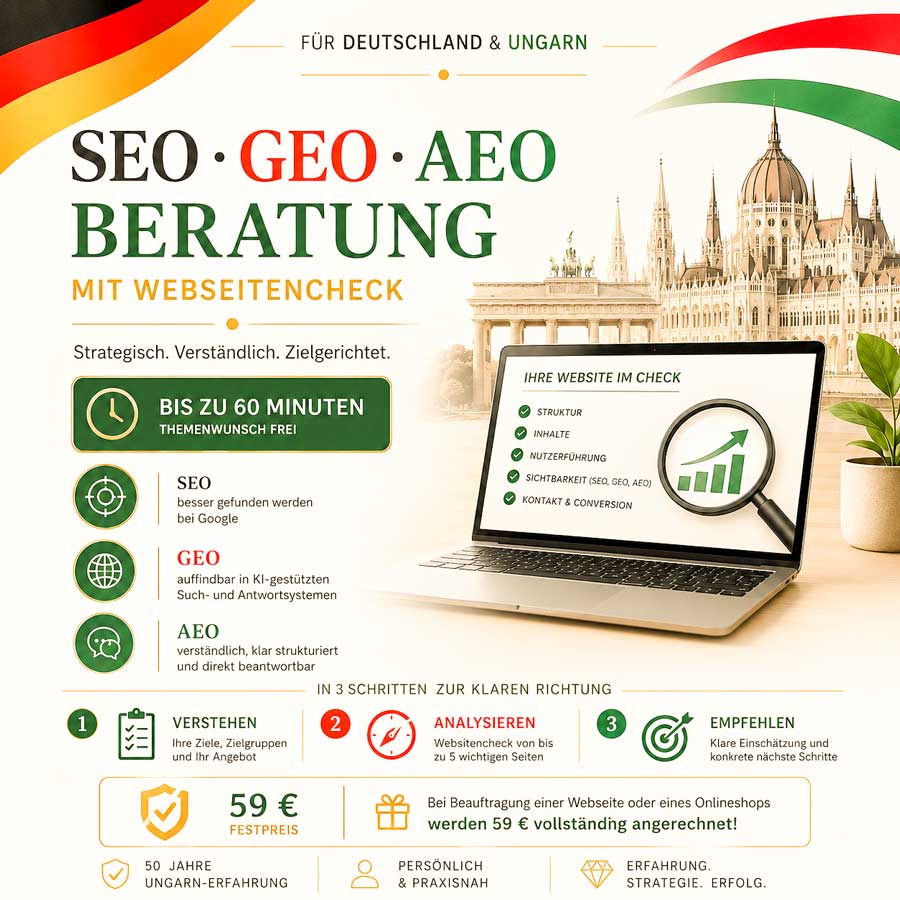
Discover which content, pages, and next steps are truly beneficial for your business.
Frequently Asked Questions about AI Visibility
Can mention in an AI answer be guaranteed?
No. A clear structure and helpful content improve the prerequisites, but do not guarantee mention or a recommendation.
Is a single blog article sufficient?
No. The homepage, service pages, about us page, contact area, and expert articles should be thematically coordinated.
Are structured data necessary?
Structured data can provide search engines with additional clues. However, they do not replace understandable and clearly visible content.
What is the most important first step?
Your own offer must be described so specifically that a new reader immediately understands what is offered, who the service is for, and where it is available.
Conclusion
An understandable website remains the most important basis for SEO, GEO, and AEO. It describes services concretely, names target groups and regions, answers real customer questions, and guides visitors via sensibly named internal links.
AI visibility is not created by repeating a search term as often as possible. It is created through professionally helpful content, a clear positioning, verifiable information, and a technically clean website.


