

Old Postcards USA: Places, Regions, and History
From New York to Yellowstone: Regions and Habitats Behind 36 Historic Postcards
Marion Schanné August 6, 2026. Hungary
Old, historical postcards are more than decorative travel pictures. They connect specific places and reveal which cities, landscapes, and holiday regions people perceived across great distances. The collection considered here comprises 36 cards. Its geographical focus is clearly on the USA: 27 motifs originate from American cities, states, or landscapes. Nine other motifs lead to England, Canada, Barbados, Bermuda, Colombia, and Switzerland.
For regional classification, not only the places of origin are interesting. The documented destinations are equally informative. 32 shipments went to Austria, one to Germany; for three motifs, no postal destination is documented. Vienna, Salzburg, and Kirchberg am Wechsel appear particularly frequently. This creates a geographical arc between the metropolises, coasts, national parks, and holiday resorts of North America and the urban and rural habitats of Central Europe.
This article therefore does not deal with the condition or evaluation of individual cards. The focus is on regional conditions: city structure, transport, landscape, everyday life, tourism, supply, and the spatial differences between regions of origin and destination.
Geographical Distribution at a Glance
27 motifs from the USA: New York City, Miami Beach, San Francisco, Chicago, Newark, Seattle, Buffalo, Omaha, St. Louis, Hawaii, Boonville, Anaheim, Niagara Falls, Adirondack Mountains, Arlington, Yellowstone, and other regions.
9 motifs from other countries and territories: England, Canada, Barbados, Bermuda, Colombia, and Switzerland.
Postal destinations: 32 times Austria, once Germany, and three times without documented destination country.
All 36 Places with Fronts, Backs, and Postal Information
The digital collector's catalog assigns each number to a place of origin and a destination. This allows direct tracing of regional connections.
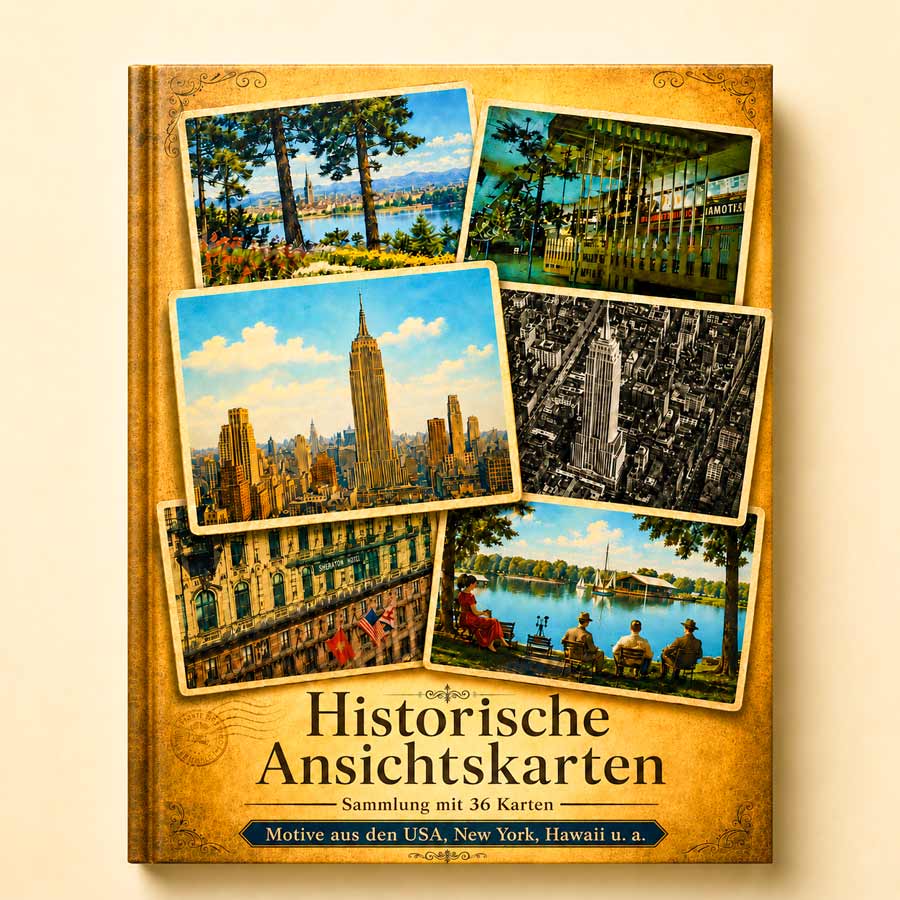
View the catalog "Historical Postcards USA – 36 Cards" now
Why the Regional Classification of Historical Places is Important
A place name alone does not explain why a region has a special effect. New York stands for vertical density, public transport, and an extraordinary mix of living, working, commerce, and culture. Hawaii, in contrast, is characterized by its island location, ports, airports, and long distances between islands. Yellowstone, in turn, is not an urban area but a vast protected area, whose accessibility is determined by roads, park entrances, seasons, and distances.
The European destinations also differ significantly. Vienna has a dense network of subways, trams, buses, and S-Bahn. Salzburg combines a compact historic city with an efficient trolleybus, bus, and S-Bahn system. Kirchberg am Wechsel represents life in a rural, alpine-adjacent municipality in Lower Austria, while Villach is a transport hub in the Alps-Adriatic region between Austria, Italy, and Slovenia.
Such differences help to correctly classify historical place names. A shipment from a large American city to Vienna follows a different geographical relationship than a connection from an island region to Kirchberg am Wechsel or from the English coast to Frankfurt am Main.
The 36 Origin Regions and Their Destinations
1. New York City, USA – Destination Kirchberg am Wechsel, Austria
New York City is characterized by high building density, strong functional mix, and exceptionally efficient public transport. Subway, buses, regional trains, ferries, footpaths, and bicycle traffic connect five very different boroughs. Kirchberg am Wechsel presents a clear contrast: the Lower Austrian municipality is located in a rural mountain region where daily life, supply, and mobility are more strongly determined by regional centers and greater distances.
2. Miami Beach, Florida, USA – Destination Vienna, Austria
Miami Beach is located on a narrow barrier island between the Atlantic and Biscayne Bay. Tropical climate, beaches, hotels, and an international service economy characterize daily life, while flood protection, drainage, and adaptation to heat play a central role. Vienna also has a well-developed tourist infrastructure, but it is a Central European inland metropolis with dense public transport and significantly stronger seasonal temperature differences.
3. San Francisco, California, USA – Destination Vienna, Austria
San Francisco is located on a hilly peninsula between the Pacific and the bay. The topography influences street layout, neighborhoods, viewpoints, and transportation systems. Dense residential areas stand next to port facilities, technology jobs, and heavily frequented business districts. Vienna is flatter, spatially larger, and characterized by a dense network of rail-bound transport. Both cities combine historic buildings with modern service economies.
4. New York City, USA – Destination Vienna, Austria
A second connection between New York and Vienna highlights two internationally significant cultural and economic centers. New York organizes its daily life with short distances in dense neighborhoods and an extensive local transport system. Vienna combines compact Gründerzeit districts, outer districts, and regional train connections. In both cities, public spaces, museums, theaters, commerce, and gastronomy play a formative role.
5. New York City, USA – Destination Vienna, Austria
New York is simultaneously a port city, financial center, immigration city, and transport hub. Its location on the Hudson River, East River, and Atlantic still influences urban development and logistics. Vienna is located on the Danube and is also an important hub between national and international transport axes. Both metropolises demonstrate how rivers, train stations, and large transport networks structure economic areas.
How strongly places remain in memory through recurring images, travel memories, and well-known landmarks is also explained in our article on historical Hungarian postcards and currently visitable travel destinations. It becomes clear there how old place views can be connected with current regional perception.
6. Chicago, Illinois, USA – Destination Salzburg, Austria
Chicago is located on the southwest shore of Lake Michigan and combines an inland port, railway, air traffic, and an extensive light rail and bus system. The lake shapes the climate, leisure, and cityscape. Salzburg is significantly smaller but combines a compact city center with an efficient trolleybus, bus, and S-Bahn network. Both cities benefit from their role as regional centers but differ greatly in scale and settlement density.
7. Newark, New Jersey, USA – Destination Vienna, Austria
Newark is part of the densely populated New York metropolitan area. Its airport, port, rail connections, and highways make the city an important transport and logistics hub. Vienna fulfills a comparable hub function within Austria, but with a stronger emphasis on urban public transport and international rail connections. Daily life in both regions is closely linked to commuting, services, and supra-regional accessibility.
8. New York City, USA – Destination Vienna, Austria
The New York–Vienna connection also represents two cities where residential neighborhoods have very different social and architectural characteristics. New York ranges from densely built business districts to quiet rows of houses and coastal residential areas. Vienna is also divided into clearly distinguishable districts. Local supply, public transport, and local centers determine the quality of life in both cities.
9. Seattle, Washington, USA – Destination Vienna, Austria
Seattle lies between the saltwater of Puget Sound and the freshwater of Lake Washington. Hills, bridges, and waterways make transport planning challenging. Port economy, technology, aviation, and rail logistics are important parts of the regional economy. Vienna has no coastline but is internationally connected via the Danube, rail, and airport. Both cities invest in pedestrian, bicycle, and public transport.
10. Buffalo, New York, USA – Destination Vienna, Austria
Buffalo is located on Lake Erie and at the beginning of the Niagara River. Its location on the Great Lakes fostered port, industry, trade, and exchange with Canada. Today, the region combines urban neighborhoods with extensive suburbs and water-related recreational areas. Vienna is more densely populated and has a more comprehensive inner-city transport network, but shares with Buffalo the importance of waterways and regional industrial history.
11. Newark, New Jersey, USA – Destination Vienna, Austria
Another Newark reference underscores the importance of the northeastern US urban belt. Large cities, ports, and airports are located close to each other there. Traffic functions across borders between municipalities and states. Vienna is both a city and an Austrian federal state and organizes many tasks within a more unified administrative structure. Both areas are heavily influenced by daily commuter flows.
12. Omaha, Nebraska, USA – Destination Salzburg, Austria
Omaha is located on the Missouri River and forms an economic center of the Great Plains region. Roads, railways, and logistics connect agricultural areas with national markets. The city is spatially more extensive than Salzburg and more focused on road traffic. Salzburg, on the other hand, has a compact historical structure and short connections between the city center, train station, and surrounding communities.
Those who want to precisely classify the connection between the place of origin, postmark, route, and destination region will find further technical information in the article Buy old postcards from Hungary: used cards and their postal traces. The principles explained there can also be applied to international card collections.
13. St. Louis, Missouri, USA – Destination Vienna, Austria
St. Louis is located on the Mississippi near the confluence of the Missouri. River trade, rail, and road transport made the city an important link between the east and west of the USA. Vienna is also located on a major European river. The Danube connects the city with Central and Southeast Europe. In both regions, bridges, riverbanks, and supra-regional transport axes shape spatial development.
14. Miami Beach, Florida, USA – Destination Vienna, Austria
Miami Beach is not only a holiday resort but a densely built city with residential areas, municipal services, and high seasonal demand. The narrow island location limits space and makes bridge connections particularly important. Vienna has more space for different districts and a larger rail network. Common to both places is the international orientation of tourism, gastronomy, and accommodation.
15. Waikiki and Honolulu, Hawaii, USA – Destination Vienna, Austria
Honolulu is the political and economic center of Hawaii, Waikiki one of the most famous holiday districts in the Pacific region. Due to its island location, airports and ports are indispensable for supply and mobility. Road space is particularly scarce and heavily used on Oʻahu. Vienna is continentally integrated and more easily connected to neighboring regions by rail and road, but also has an international airport and a global visitor base.
16. Kiamesha Lake, New York, USA – Destination Vienna, Austria
Kiamesha Lake is located in the Catskills region north of New York City. Lakes, forests, resorts, and smaller settlements characterize the area. The region thrives on nature recreation, regional tourism, and accessibility via roads. Vienna, as a destination, represents the urban antithesis: dense public transport, large cultural institutions, and a supply that is largely accessible without long car journeys.
17. Ridgewood, USA – Destination Vienna, Austria
Ridgewood is an example of American urban and suburban areas where residential areas, commercial streets, and local transport axes intertwine. Such regions are often closely linked to a larger metropolis. Vienna also has outer districts with quieter buildings, but trams, buses, and S-Bahn connect many residential areas closely to the center. The differences are particularly evident in density and everyday mobility.
18. Barbados – Destination Kirchberg am Wechsel, Austria
Barbados is a Caribbean island state whose economy, supply, and daily life are strongly influenced by its coastal location, port, airport, and tourism. The road network handles a large part of internal mobility. Kirchberg am Wechsel, on the other hand, is located in an alpine-adjacent inland region. There, altitude, winter weather, regional roads, and the connection to larger Austrian towns determine accessibility.
Compare Geographical Data Directly with the 36 Catalog Numbers
The catalog brings together the place of origin, destination, stamp details, and motif description for each number.
To the digital catalog with all 36 historical postcards
19. Boonville, New York, USA – no documented destination country
Boonville is located in the rural north of New York State. Small towns in this region perform important functions for surrounding communities: shopping, schools, administration, and local services. Distances are greater than in New York City, and daily life is more geared towards road traffic. Forests, agriculture, and winter sports characterize regional perception.
20. Coventry, England – Destination Villach, Austria
Coventry is an English city with strong industrial, university, and transport functions in the West Midlands. Rail and road connections link it to Birmingham and other economic areas. Villach is located in southern Austria and is an important hub in the Alps-Adriatic region. The city connects Carinthia with Italy and Slovenia and is located near several lakes and alpine passes.
21. Newark, New Jersey, USA – no documented destination country
Newark particularly clearly shows how closely cities in the northeastern USA are intertwined. The airport serves the entire metropolitan area, the port is one of the important freight hubs on the East Coast, and railway lines lead directly to Manhattan and other centers. Living, logistics, education, and administration come together in a confined space here.
22. Montréal, Canada – Destination Vienna, Austria
Montréal is located on the Saint Lawrence River and is a major Francophone cultural, university, and economic center. Metro, buses, suburban trains, and a dense road network handle mobility. The climate requires an infrastructure that can cope with cold winters and large temperature fluctuations. Vienna is also multilingual and internationally oriented but has a milder climate and a more cohesive Central European rail network.
23. Anaheim, California, USA – Destination Kirchberg am Wechsel, Austria
Anaheim is part of the densely populated Orange County and is characterized by its leisure industry, hotels, wide roads, and large-scale visitor flows. Tourist facilities are closely linked to regional highways and airports. Kirchberg am Wechsel is significantly smaller and characterized by mountains and forests. While Anaheim organizes mass tourism, Kirchberg rather stands for nature-oriented recreation and regional manageability.
The detailed article Bük and Bükfürdő: Spa Town, Spa History, and Historical Postcards also shows how tourism, accommodation, transport routes, and regional development have intertwined over decades. The spa town in western Hungary offers a readily understandable European comparative example.
24. Cambridge, England – Destination Salzburg, Austria
Cambridge is a compact university city where research, education, and cycling significantly shape urban life. Historic buildings, modern institutes, and residential areas are closely intertwined. Salzburg also boasts an internationally renowned educational and cultural landscape. Both cities have historical centers but must also manage commuters, visitors, and regional traffic flows.
25. USA, specific region not designated – Destination Vienna, Austria
The USA encompasses extremely diverse habitats: densely populated coastal metropolises, industrial inner cities, agricultural plains, mountains, deserts, and islands. Therefore, general statements about daily life and infrastructure are only possible to a limited extent. The destination Vienna contrasts with this as a clearly defined European metropolis. For regional classifications, the specific city or landscape is always crucial.
26. Puerto Colombia, Colombia – without documented destination country
Puerto Colombia is located on the Caribbean coast in the Atlántico department near Barranquilla. The region is characterized by its coast, beaches, fishing, tourism, and proximity to a significant port and industrial area. The tropical climate dictates construction methods, daily rhythms, and leisure activities. As a major city, Barranquilla fulfills many supra-regional functions for trade, education, transport, and supply.
27. Niagara Falls, New York, USA – Destination Ferlach, Austria
Niagara Falls is located on the border between the USA and Canada. The waterfall, river, energy generation, and international tourism define the area. Border crossings and bridges connect two states and two urban systems. Ferlach is located in southern Carinthia near the Slovenian border. Life near the border is also part of daily regional life there, albeit in a much smaller alpine environment.
28. Yoho National Park, Canada – Destination Vienna, Austria
Yoho is located in the Canadian Rocky Mountains in British Columbia. Steep valleys, passes, railway lines, and the Trans-Canada Highway determine accessibility. The Spiral Tunnels demonstrate how technical infrastructure was adapted to difficult mountain topography. Vienna, as a destination, is an urban transport hub where infrastructure must manage not altitude differences but density, commuter volume, and the integration of various modes of transport.
29. Black Rock near Brighton, England – Destination Frankfurt am Main, Germany
- Choosing a selection results in a full page refresh.
- Opens in a new window.